Showing posts with label Bear. Show all posts

Spectacled Bear

Sunday, July 1, 2012


The Life of Animals | Spectacled Bear | The spectacled bear is a species of medium size bear native in South America has black fur with a distinctive tan markings around the face and upper chest, although not all Andean bears have "spectacle" markings. Males can weigh 100-200 kg (220 - 440 pounds) and 35 women -82 kg (77-181 lbs). Spectacled bears are the only species of bear native to South America survived, and the only surviving member of the subfamily Tremarctinae.


Like other bears, mothers are protective of their young and attacked the poachers. Bears herbivores glasses are more than most other bears, generally about 5-7% of their diet is meat. The most common foods for these bears are cacti, palm nuts, bulbs, orchids, fruit fallen on the forest floor and palm leaves closed. Prey is usually very small, but these bears can front-grown deer, llamas and domestic cattle and horses.


Probably, some bears have become accustomed to eating animals, but bears are actually more likely to eat carrion and livestock farmers as some may accidentally take the spectacled bear killed. Because of fear of loss of inventory, the bears can be shot on sight The population bear glasses is at risk of a number of reasons. Bears are hunted by the locals because of a belief that eating animals (bears with glasses, even if they do not eat large quantities of meat). The gallbladder of spectacled bears are valued in traditional Chinese medicine and can fetch a higher price in international market.

As food sources of bears are disappearing, is based on food crops. For this reason, farmers see the bears, such as competition and hunt them. The law against hunting bears exist, but is rarely applied. In the documentary Paddington Bear: The Early Years, British actor Stephen Fry is a spectacled bear named Yogi, which was held in a small cage by Andean villagers (see also Paddington Bear).


Fry took an interest in bears to accompany the documentary, Stephen Fry and spectacled bears, and he also wrote and published their experiences to save the Spectacled Bear: A Peruvian daily. The BBC documentary "Spectacled Bears: Shadows of the Forest" Bear looks at some of the research was conducted in Peru and Ecuador, and that researchers are discovering.

Asiatic black bears

Thursday, April 5, 2012

 
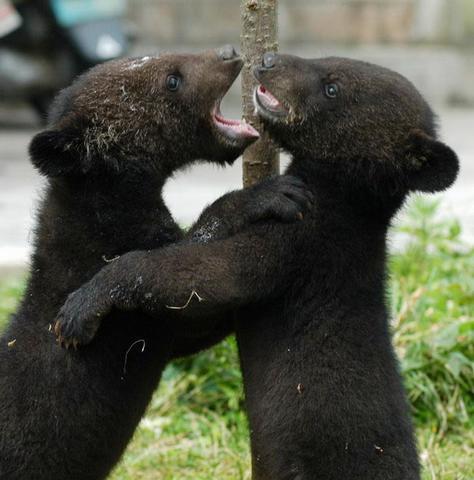
The Life of Animals | Asiatic black bears | Asiatic black bears are similar in general appearance to brown bears, but they are lighter and slimmer built limbs. The skulls of Asiatic black bears are relatively small, but solid, especially in the lower jaw. The ears are bell-shaped, and are longer in proportion than that of the Great Bear, and protrude from the head, the lips and nose are larger and more mobile than those of brown bears Adult black bears are smaller than American black bears, on average, although large males, the size of several other bears species.They measure 70-100 cm (28-40 inches) at shoulder height and 120 to 195 cm (47 may exceed - 77 in) in the body length. Females weigh about 65-90 kg (143-198 lbs), with large up to 140 kg (308 lbs).


Within Sikhote-Alin,
the breeding season of black bears occurs earlier than in the brown bear, from mid June to mid August. Like brown bears, Asiatic black bears have delayed implantation. The skull of a newborn black bear cubs bear close resemblance to those of adult shall bear litters can consist of 1-4 boys, 2 is the average. Black bears usually inhabit deciduous forests, deserts, forests and forests thornbrush. With the exception of Malaysia, black bears come in all the countries in mainland Southeast Asia. Black bears in the southern Japanese islands of Honshu and Shikoku, and occur in Taiwan and Hainan. There is no definitive estimate of the number of black bears Japan presented estimates of 8 to 14.000 bears live on Honshu, although the reliability is now questionable.


Unfounded estimates from China give varying estimates between 15 - 46,000, with a government estimate of 28 000 Accounts of the quality of the black bear's fur varies. In British India, was the fat only practical use for black bear carcass.  Asiatic black bears have been hunted for their parts in China since the Stone Age. Black bear meat is edible.

Sun Bear

 
The Life of Animals | Sun Bear | The sun bear is 120-150 cm (47-60 inches) long, so that it is the smallest member of the Baer family (Ursidae) Males typically 10-45% larger than the females,  The shoulder height is about 60-78 cm (24-28 inches) The Sun Bear possesses sickle-shaped claws that are relatively light in weight. The bear is used to extract honey from beehives Unlike other bears, the sun bear's fur is short and smooth. The sun bear does not hibernate, and, as a result, it can reproduce all year round. A female Sun Bear can produce 1-2 pups per year. Sun bears undergo an approximately 96 days gestation period, after the 300 to 400 g born blind and hairless cub is.


Male Malayan sun bears are larger than females. During the time of mating, the Sun Bear is showing behavior such as hugging, mock fighting and head bobbing with his buddy. As a primarily nocturnal creatures, the Sun Bear tends, during the day, do not rest on the lower extremities, far above the ground. Because it spends so much time in the trees, the sun bear sometimes cause damage to property.


Other potential predators include the leopard, clouded leopard, the, sun bears and the larger sympatric relative, the Asiatic black bear The bear loose skin on the neck makes it possible to twist their bodies into his skin far enough to turn around and bite its attacker when grabbed.


Sometimes, it bears captured or bred for pets, a role for which they are considered desirable, be due to their relatively inoffensive nature and small size compared to other bears.  The IUCN classified the Sun Bear "flawed data" to "vulnerable" status in 2007.

American Black Bear

Friday, March 2, 2012

 
The Life of Animals | American Black Bear | Although They all live in North America, American black bears are not closely related to brown bears and polar bears; genetic studies reveal That They split from a common ancestor and 5:05 mya.Both American Asiatic black bears are Considered sister taxa, and are more closely related to each other than to other species of bear.

The Ancestors of American black bears and Asiatic black bears from sun bears diverged 4:58 mya. The American black bear is then split from the Asian black bear mya.The 4:08 earliest fossils of the American black bear, the which were located in Port Kennedy, Pennsylvania, greatly resemble the Asiatic species, though specimens later grew to sizes comparable to grizzlies.From the Holocene to present, American black bears seem to have shrunk in size but this has been disputed Because of problems with these fossil specimens dating.


The American black bear lived during the same period as short-faced bears (Arctodus Simus and A. pristinus) and the Florida spectacled bear (Tremarctos floridanus). These bears evolved from bears Tremarctine That had emigrated from Asia to North America 7-8 ma. The short-faced bears are thought to have been Heavily Carnivorous FL spectacled bear and the more herbivorous, while the American black bears remained arboreal omnivores , like Asian Their Ancestors.  The skulls of American black bears are broad, with narrow muzzles and large jaw hinges.


The Hind legs are longer than Asiatic black bears Those of. Black bears are highly dexterous, being capable of opening screw-top jars and manipulating door latches. Black bear weight tends to Vary According to age, sex, health, and season. Black bears on the East Coast growing niche to be heavier on average than Those on the West Coast. The North American Bear Center, located in Ely, Minnesota, is home to the world's largest captive male and female black bears.

Sloth bear

Friday, December 23, 2011


The Life of Animals | Sloth bear | Sloth bears are distinguished from Asian black bears by Their lankier builds, longer, shaggier coat, pale muzzle and white claws. Sloth bear muzzles are thick and long, with small jaws and bulbous snouts with nostrils wide. Sloth bear is completely black fur (rusty for some specimens), save for a whitish Y or V shaped mark on the chest. This feature, the which is also present in Asian black bears and sun bears, is thought to serve as a threat display, as all three species are sympatric with tigers.


Adult sloth bears weigh 100 kg (220 lbs) on average, though variously weight can range from 55 kg (121 lbs) to 190 kg (400 lbs). Cubs are born blind, and Their eyes open after four weeks Sloth bear cubs Quickly develop compared to most other species of bears: Will They start walking a month after birth, Become independent at 24-36 months, and Become sexually mature at the age of 3 years.

Individuals riding positions are maintained by cubs through fighting. Intervals the between litters can last 2-3 years Will occasionally Bengal tigers prey on sloth bears. Tigers sloth bears usually give a wide berth, though some specimens may bear Become habitual killers and it is not uncommon to find sloth bear fur in tiger scats.

When confronted by face to face tigers, sloth bears will of charge at Them, crying loudly. A young, or already satiated tiger Will usually retreat from an assertive sloth bear, as the bear's claws can inflict serious wounds, and most tigers end the hunt if the bears Become aware of the tiger's presence before the pounce. A female bear with cubs was observed to stand its ground and PREVAIL in a Confrontation against two tigers (one female, one male) in rapid succession. Sloth bears may scavenge on tiger kills As tigers are known to mimic the calls of sambar deer to attract Them, sloth bears React fearfully event to the sounds made by Indian leopards deer themselves can also be a threat, as They are Able to follow sloth bears up trees. Will sloth bears occasionally chase leopards from Their kills. Sloth bears are sympatric with Asiatic black bears in Northern India, and the two species, along with the sun bear, co-exist to some of the national parks and wildlife sanctuaries.

Dhole packs sloth bears may attack, though They are not a usual prey items. When attacking sloth bears, dholes Will try to Prevent the bear from retreating in caves. Apparently Asian elephants do not tolerate sloth bears in Their vicinity. The reason for this is unknown, as individual elephants known to maintain composure Their near tigers have been reported to charge the Indian rhinoceros bears have a similar intolerance for sloth bears, and will of charge at Them