Showing posts with label Marsupial. Show all posts

Bandicoot

Wednesday, December 28, 2011

  
The Life of Animals | Bandicoot | Their fur is short and usually brown, yellow or black The embryos of bandicoots, unlike other marsupials, form a placenta-like organ That connects it to the uterine wall. The infected domestic animals Them shed in urine, faeces, and placental products. There were the resource persons thought to be two families in the order the short-legged and Mostly herbivorous bandicoots, and the longer-legged, Carnivorous Nearly bilbies.


First, the bandicoots of the New Guinean and far-northern Australian rainforests were the resource persons deemed distinct from all other bandicoots and were the resource persons grouped together in the separate family Peroryctidae.


More recently, the bandicoot families were the resource persons in Peramelidae reunited, with the New Guinean species split into four genera in two subfamilies, Peroryctinae and Echymiperinae, while the "true bandicoots" occupy the subfamily Peramelinae.  PANDI-kokku, (loosely, pig-rat), the which originally Referred to the unrelated Indian Bandicoot Rat.

Quoll

Wednesday, December 21, 2011


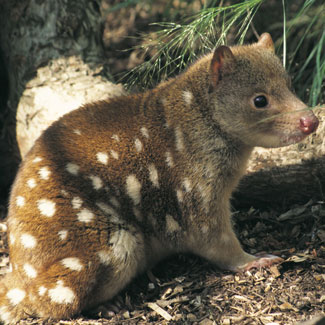
The Life of Animals | Quoll | Adults are the between 25 and 75 centimetres (10 and 30 in.) long, with hairy tails about 20 to 35 centimetres (8 to 10 in.) long. Females have six nipples and develop a pouch During the breeding season, the which opens toward the tail (with the exception of the tiger quoll, the which has a true pouch) They are rearing young. The average weight differs greatly Depending on the species - male western and eastern quolls weigh about 1.3 kilograms (3 lb) and females 0.9 kilograms (2 lb). The tiger quoll is the largest, with the male Weighing about 7 kilograms (15 lb) and the female 4 kilograms (9 lb). The northern quoll is the smallest, and the male weighs on average 400-900 grams (14-32 oz), and the female 300-500 grams (11-18 oz).


The quoll is indigenous to mainland Australia, New Guinea, and Tasmania. Although primarily ground-dwelling, the genus has developed secondary arboreal characteristics. Each species of quoll lives in distinct geographical areas. The tiger quoll and eastern quoll species are exclusively mesic zone, that is They inhabit moister habitats. The western quoll also inhabits mesic habitats, but has adapted to arid regions across inland Australia, while the northern quoll inhabits tropical habitats of high rainfall.

The quoll is a Carnivorous marsupials. It The quoll marks its territory Several kilometres away from its den. A male's territory Often Overlaps many females' territories and male and female quolls for only meet ing. Quolls have communal "bathroom" spots, usually on an outcropping used for marking territory and social functions. These communal latrines may have up to one hundred droppings in Them Mostly The quoll is a solitary creature, limiting contact with others to ing or other social activities Such as using the latrines The quoll is Mostly Carnivorous; the Smaller quolls primarily eat Insects, birds, frogs, lizards and fruit; the larger species eat birds, Reptiles, and Mammals, including echidnas and possums. The tiger quoll's diet is dominated by Mammals Such as brushtail possums, rabbits and Hares.

The other species of quoll have also been known to eat carrion. The quoll's Paws and vibrissae allow it to reach into small Burrows to find prey. The quoll Hunts by stalking. Depending on the size of its prey, the quoll may leap or pounce on it. Once a female has been impregnated quoll, the folds on her stomach into a pouch converting That opens at the back. A baby quoll, or pup, is the size of a grain of rice. Post-ovulation, pouches Became deep and wet.  


Numbat


The Life of Animals | Numbat | The numbat is a small, colorful creature the between 35 and 45 centimetres (14 and 18 in.) long, including the tail, with a finely pointed muzzle and a prominent, Bushy tail about the same length as its body. The Underside is cream or light gray, while the tail is covered with long gray hair flecked with white. Weight varies the between 280 and 700 grams (9.9 oz and 25).


Most Ecosystems with a generous supply of Termites have a fairly large creature with a very long, thin, sticky tongue for penetrating termite Colonies, and powerful forelimbs with heavy claws. Like other Mammals That Termites eat or ants, the numbat has a degenerate jaw with up to 50 very small non-functional teeth, and although it Able to chew, rarely does so, Because of the soft nature of its diet. Among terrestrial Mammals Uniquely, there is an additional cheek tooth the between the premolars and molars; it is unclear whether this represents a supernumary molar tooth or a deciduous tooth retained into adult life. As a result, although not individuals have the same dental formula, in general, it follows the unique pattern Like many ant-eating animals, the numbat has an unusually long, narrow, tongue, coated with sticky saliva produced by large submandibular glands.

The digestive system is Relatively simple, and lacks many of the adaptations found in other entomophagous animals, presumably Because Termites are Easier to digest than ants, having a softer exoskeleton. Apparently Numbats are Able to gain a considerable amount of water from Their diet, since Their kidneys lack the usual specialisations for retaining water found in other animals living in arid environments Their Numbats also possess a sternal scent gland, the which may be used for marking its territory .

Although the numbat finds termite mounds primarily using scent, it has the highest visual acuity of any marsupial, and, unusually for marsupials, has a high proportion of cone cells in the retina. Numbats regularly enter a state of torpor, the which may last up to fifteen hours a day During the winter months Numbats were the resource persons formerly found across southern Australia from Western Australia across as far as Northwestern New South Wales. However, the range has Declined significantly since the arrival of Europeans, and the species has survived only in two small patches of land in the Dryandra Woodland and the Perup Nature Reserve, Both in Western Australia Numbats breed in February and March, normally producing one litter a year, although They can Produce a second if the first is lost.

The young are 2 centimetres (0.79 in) long at birth, and crawl to the teats, and Remain attached until late July or early August, by the which time They have grown to 7.5 centimetres (3.0 in). It was discovered by an exploration party were the resource persons WHO Exploring the Avon Valley under the leadership of Robert Dale.

Pademelon

  
The Life of Animals | Pademelon | Red-necked pademelons can be found in the coastal regions of Queensland and New South Wales. In Red-legged pademelons can also be found in south-central New Guinea. The dusky pademelon lives in New Guinea and Surrounding islands. It was Previously Called the Aru Islands wallabies. Before that, it was Called the philander ("friend of man"), the which is the name it bears in the second volume of Cornelis de Bruijn's Travels, originally published in 1711; the Latin name of this species is Called after De Bruijn.


The natural habitat of the pademelon is in thick scrubland or dense forested undergrowth. They also make-tunnels through long grasses and bushes in swampy country.


Aside from being killed for meat and Their soft fur, Their numbers have been reduced by the introduction of predators Such as feral cats, dogs, and foxes. Important Tasmanian pademelons were the resource persons to the thylacine's diet, and are still preyed on by quolls, Tasmanian devils and wedge-tailed eagles.

Possum

  
The Life of Animals | Possum | The common brushtail possum was introduced to New Zealand by European Settlers in an Attempt to Establish a fur industry. There are no native predators of the possum in New Zealand.


Since 1996, Efforts have been made to use possum fur in clothing. A blend of Australian possum fur with merino brushtailed wool was developed by Untouched World, a New Zealand fashion label. The product is Called merinomink, eco-possum, possumdown, eco fur or possum wool, and accounts for 95% of all commercially caught possum fur. Possum fur is also used for fur trim, jackets, bed throws, and possum leather gloves. All the fur is obtained from wild-caught possums, the which are Considered pests.

Almost half (13.3 million hectares) of New Zealand's vegetated land is under some form of possum control, either for conservation Reasons, or to Reduced the spread of bovine tuberculosis.

Tasmanian devil


The Life of Animals | Tasmanian devil | The Tasmanian devil is the largest surviving Carnivorous marsupials in Australia The fur is usually black, Often with irregular white patches on the chest and rump (although approximately 16% of wild devils do not have white patches) These markings suggest That the devil is most active at dawn and dusk, and They are thought to draw biting attacks toward less Important areas of the body, fighting as the between devils Often leads to a concentration of scars in That Region. Males are usually larger than females, having an average head and body length of 652 mm (25.7 in), a 258 mm (10.2 in) tail and an average weight of 8 kg (18 lb). Females have an average head and body length of 570 mm (22 in), a 244 mm (9.6 in) tail and an average weight of 6 kg (13 lb), although in western Tasmanian devils growing niche to be Smaller. Devils have five long toes on Their forefeet, four pointing to the front and one coming out from the side, the which the devil Gives the ability to hold food. The Hind feet have four toes, and the devils have non-retractable claws The devils have a stocky Relatively low center of mass. Devils are fully grown at two years of age and live longer Few devils than five years old in the wild The devil stores body fat in its tail, and healthy devils have fat tails.


The Tasmanian devil has an Exceptionally strong bite for its size, generating a force of over 553 N (1.220 lb). The jaw can open to 75-80 degrees, allowing the devil to generate the large amount of power to tear meat and crush bones sufficient force to allow it to bite through thick metal wire The power of the jaws is in part due to its comparatively large head. The teeth and jaws of Tasmanian devils resemble Those of hyenas, an example of convergent evolution Dasyurid teeth resemble Those of primitive marsupials. Like all dasyurids, the devil has prominent canines and cheek teeth.


It The devil has long whiskers on its face and in clumps on the top of the head. These help the devil locate prey foraging in the dark, and aid in detecting During other devils are close feeding. The devil, unlike other marsupials, has a "well-defined, saddle-shaped ectotympanic". Since devils hunt at night, Their vision seems a to be strongest in black and white.

Wallaby


The Life of Animals | Wallaby | Very small forest-dwelling Wallabies are known as "pademelons" (genus Thylogale) and "dorcopsises" (genera Dorcopsis and Dorcopsulus,) The name, "wallaby", comes from the Eora, WHO were the resource persons the first human inhabitants of the Sydney area. Young Wallabies are known as "Joeys," like many other marsupials. Adult male Wallabies are Referred to as "bucks," "boomers," or "jacks." An adult female wallabies is known as a "doe," "flyer," or "Jill." A group or Congregation of Wallabies is Called a "court," "mob," or "Troup."


Wallabies are herbivores Whose diet consists of a wide range of grasses, vegetables, leaves, and other foliage. Due to recent urbanization, many Wallabies now feed in rural and urban areas. Mobs of Wallabies Often the same congregate around water holes During the dry season. Several Wallabies face threats. Wild dogs, foxes, and feral cats are predators Among the Wallabies face. A wallaby utilizes its powerful Hind leg to fend off predators. 

Wallabies also have a powerful tail That Is Mostly used for balance and support. Humans also pose a significant threat to Wallabies due to Increased interaction.  Wallabies are not a distinct genetic group. Typical Wallabies of the Macropus genus, like the Agile Wallaby (Macropus agilis), and the Red-necked Wallaby (Macropus rufogriseus) are most closely related to the kangaroos and wallaroos and, size aside, look very similar.

Rock-Wallabies (genus Petrogale), rather like the goats of the northern hemisphere, Specialise in rugged terrain and have modified feet adapted to grip rock with skin friction rather than dig into soil with large claws. It is not as closely related to the other Wallabies hare (genus Lagorchestes) as the hare Wallabies Wallabies are to the other.

Goodfellow's Tree-kangaroo

  
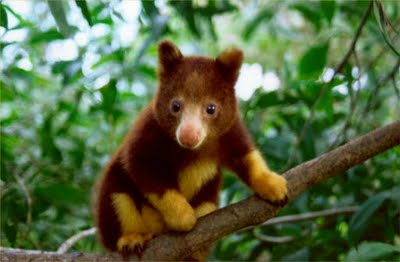
The Life of Animals | Goodfellow's Tree-kangaroo | Like other tree-kangaroos, Goodfellow's Tree-kangaroo is quite different in appearance from terrestrial kangaroos. Goodfellow's Tree-kangaroo has short, Woolly fur usually chestnut to red-brown in color, a gray-brown face, yellow-colored cheeks and feet; a pale belly, a long, golden brown tail, and two golden stripes on its backside. It weighs approximately 7 kg (about 15 lb)


Goodfellow's Tree-kangaroo is slow and Clumsy on the ground, moving at about walking pace and hopping awkwardly, Leaning its body far forward to balance the heavy tail. It climbs by wrapping its forelimbs around the trunk of a tree and hopping with the powerful Hind legs, allowing the forelimbs to slide.

Matschie's Tree-kangaroo


The Life of Animals | Matschie's Tree-kangaroo | With a body and head length of 20 to 32 inches (810 mm), Matschie's Tree-kangaroo are much Smaller than Australia's well-known red kangaroo. An adult male weighs the between 20 and 25 lb (9-11 kg). Lasts 32 days and gestation of Captive Bred individuals Joeys leave the pouch after 13 ½ months. The average life span of the Matschie's Tree-kangaroo in the wild is unknown, but is at least 14 years.


The most distinctive trait of all tree kangaroos is the Hair Whorl They possess. The Matschie's tree kangaroo is golden on its ventral side, the lower parts of its Limbs, ear edges, belly, and tail, and the rest of its body is a chestnut brown color, except for usually having a dark stripe down its back. The Matschies' are similar in color and size to Dendrolagus dorianus, the Doria's tree kangaroo. 


The 4th and 5th digits of Their feet are enlarged, the 1st digit is absent, and the 2nd and 3rd digits are syndactylous (two digits That Fused together look like one). Out of all of the Dendrolagus species, the Matschie's tree kangaroo is the best vertical climber and has more strength in its muscles than any others. Their tails help to offset Their balance while moving swiftly through the trees since Their tails are about the same length as Their head and body size. Sexual dimorphism is very low, with males and females being of about equal sizes. The upper and lower jaws of the Matschie's tree kangaroos are different too in Addition to Them being different in body size. The upper jaw has three incisors, one canine, one premolar, and four molars, while the lower jaw has one very sharp incisors, no canines and low-crowned molars.


The Matschie's tree kangaroos are Mainly folivorous, eating anything from leaves, sap, Insects, flowers, and nuts. It was also found Eaten That They have chickens in captivity as well as feeding on a variety of plants, carrots, lettuce, bananas, potatoes, hard-boiled egg eggs, and yams. Tim Flannery ing documents the techniques of the Matschies' in his text Mammals of New Guinea by stating Occurs Pls ing a female Advances on a male while on the ground; They touch each other's noses and click Their Tongues. The Matschie's tree kangaroos have no embryonic diapauses or delayed implantations and are Able to get pregnant as soon as the joey leaves the pouch.

Kowari

Tuesday, December 20, 2011

  
The Life of Animals | Kowari | also known as the Brush-Tailed Rat Marsupials, Kayer Rat, Byrne's Crest-tailed marsupials Rat, Bushy-tailed Rat and Kawiri Marsupials, is a small Carnivorous marsupials native to the dry grasslands and deserts of central Australia. The Kowari is a ground dwelling Carnivorous marsupials, living either in its own dug Burrow or in the hole of another mammal. The Kowari is a solitary animal and marks its territory with a scent gland from secreations and leaving scats and urine at Certain Places throught Their home territory When approached, Kowari are very aggressive with much hisssing and chattering and thrashing of its tail. Young Kowaris Their mothers may ride on side or back (2-3 months old). The young Become independant 100 days after birth.


When cold and food supply is scarce, the Kowari may Become torpid (a form of hibernation). By day, it sleeps in a Burrow (Sometimes can be seen "Sunbaking"), and at night it is a Fierce predators on Insects, the larger arthropods, and small vertebrates (eg birds, rodents, lizards) The Kowari can stalk like a paint and uses a direct-neck bite Pls killing large prey.